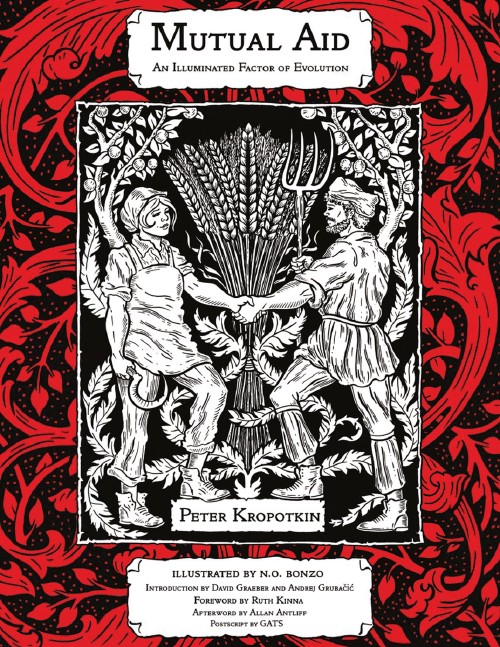
Mutual Aid: An Illuminated Factor of Evolution
Copyright 1902, PM Press
Climate Change, Cultural Analysis
All notes scanned from the PM Press edition.
But if we resort to an indirect test, and ask Nature: “Who are the fittest: those who are continually at war with each other, ox those who support one another?” we at once see that those animals which acquire habits of mutual aid are undoubtedly the fittest. They have more chances to survive, and they attain, in their respective classes, the highest development of intelligence and bodily organization. (p33)
If the numberless facts which can be brought forward to support this view are taken into account, we may safely say that mutual aid is as much a law of animal life as mutual struggle, but that, as a factor of evolution, it most probably has a far greater importance, inasmuch as it favours the development of such habits and characters as ensure the maintenance and further development of the species, together with the greatest amount of welfare and enjoyment of life for the individual, with the least waste of energy. (p33)
The ants and termites have renounced the “Hobbesian war,” and they are the better for it. Their wonderful nests, their buildings, superior in relative size to those of man; their paved roads and overground vaulted galleries; their spacious halls and granaries; their cornfields, harvesting and “malting” of grain; their rational methods of nursing their eggs and larvae, and of building special nests for rearing the aphides whom Linnaeus so picturesquely described as “the cows of the ants”; and, finally, their courage, pluck, and this superior intelligence-all these are the natural outcome of the mutual aid which they practice at every stage of their busy and laborious lives. That mode of life also necessarily resulted in the development of another essential feature of the life of ants: the immense development of individual initiative which, in its turn, evidently led to the development of that high and varied intelligence which cannot but strike the human observer.° If we knew no other facts from animal life than what we know about the ants and the termites, we already might safely conclude that mutual aid (which leads to mutual confidence, the first condition for courage) and individual initiative (the first condition for intellectual progress) are two factors infinitely more important than mutual struggle in the evolution of the animal kingdom. (p37)
As seen from the above, the war of each against all is not the law of nature. Mutual aid is as much a law of nature as mutual struggle, and that law will become still more apparent when we have analyzed some other associations of birds and those of the mammalia. A few hints as to the importance of the law of mutual aid for the evolution of the animal kingdom have already been given in the preceding pages; but their purport will still better appear when, after having given a few more illustrations, we shall be enabled presently to draw therefrom our conclusions. (p47)
Nature is variety itself, offering all possible varieties of characters, from the basest to the highest: and that is why she cannot be depicted by any sweeping assertion. Still less can she be judged from the moralist’s point of view, because the views of the moralist are themselves a result-mostly unconscious—of the observation of Nature. (p53)
Those species which willingly or unwillingly abandon it are doomed to decay, while those animals which know best how to combine, have the greatest chances of survival and of further evolution, although they may be inferior to others in each of the faculties enumerated by Darwin and Wallace, save the intellectual faculty, The highest vertebrates, and especially mankind, are the best proof of this assertion. As to the intellectual faculty, while every Darwinist will agree with Darwin that it is the most powerful arm in the struggle for life, and the most powerful factor of further evolution, he also will admit that intelligence is an eminently social faculty. Language, Imitation, and accumulated experience are so many elements of growing intelligence of which the unsociable animal is deprived. Therefore we find, at the top of each class of animals, the ants, the parrots, and the monkeys, all combining the greatest sociability with the highest development of intelligence. The fittest are thus the most sociable animals, and sociability appears as the chief factor of evolution, both directly, by securing the well-being of the species while diminishing the waste of energy, and indirectly, by favouring the growth of intelligence. (p66)
“Don’t compete!-competition is always injurious to the species, and you have plenty of resources to avoid it!” That is the tendency of nature, not always realized in full, but always present. That is the watchword which comes to us from the bush, the forest, the river, the ocean. “Therefore combine-practice mutual aid! That is the surest means for giving to each and to all the greatest safety, the best guarantee of existence and progress, bodily, intellectual, and moral.” That is what Nature teaches us; and that is what all those animals which have attained the highest position in their respective classes have done. That is also what man—the most primitive man—has been doing; and that is why man has reached the position upon which we stand now, as we shall see in the subsequent chapters devoted to mutual aid in human societies. (p76-77)
When first meeting with primitive races, the Europeans usually make a caricature of their life; but when an intelligent man has stayed among them for a longer time, he generally describes them as the “kindest” or “the gentlest” race on the earth. These very same words have been applied to the Ostyaks, the Samoyedes, the Eskimos, the Dayaks, the Aleoutes, the Papuas, and so on, by the highest authorities. I also remember having read them applied to the Tunguses, the Tchuktchis, the Sioux, and several others. The very frequency of that high commendation already speaks volumes in itself. (p91)
The land was the common property of the tribe, or of the whole stem, and the village community itself owned its part of the tribal territory so long only as the tribe did not claim a redistribution of the village allotments. The clearing of the woods and the breaking of the prairies being mostly done by the communities or, at least, by the joint work of several families-always with the consent of the community-the cleared plots were held by each family for a term of four, twelve, or twenty years, after which term they were treated as parts of the arable land owned in common. Private property, or possession “for ever” was as incompatible, with the very principles and the religious conceptions of the village community as it was with the principles of the gens; so that a long influence of the Roman law and the Christian Church, which soon accepted the Roman principles, were required to accustom the barbarians to the idea of private property in land being possible? And yet, even when such property, or possession for an unlimited time, was recognized, the owner of a separate estate remained a co-proprietor in the waste lands, forests, and grazing-grounds. Moreover, we continually see, especially in the history of Russia, that when a few families, acting separately, had taken possession of some land belonging to tribes which were treated as strangers, they very soon united together, and constituted a village community which in the third or fourth generation began to profess a community of origin. (p113)
The village community was not only a union for guaranteeing to each one his fair share in the common land, but also a union for common culture, for mutual support in all possible forms, for protection from vio-lence, and for a further development of knowledge, national bonds, and moral conceptions; and every change in the judicial, military, educational, or economical manners had to be decided at the folkmotes of the village, the tribe, or the confederation. The community being a continuation of the gens, it inherited all its functions. It was the universitas, the mir—a world in itself. (p113)
Allthing, or national folkmote, a löesögmathr used to recite the whole law from memory for the enlightening of the assembly, and in Ireland there was, as is known, a special class of men reputed for the knowledge of the old traditions, and therefore enjoying a great authority as judges." Again, when we are told by the kussian annals that some stems of North-West Russia, moved by the growing disorder which resulted from “clans rising against clans,” appealed to Norman varingiar to be their judges and commanders of warrior scholae; and when we see the knyazes, or dukes, elected for the next two hundred years always from the same Norman family, we cannot but recognize that the Slavonians trusted to the Normans for a better knowledge of the law which would be equally recognized as good by different Slavonian kins. In this case the possession of runes, used for the transmission of old customs, was a decided advantage in favour of the Normans; but in other cases there are faint indications that the “eldest” branch of the stem, the supposed motherbranch, was appealed to to supply the judges, and its decisions were relied upon as just;? while at a later epoch we see a distinct tendency towards taking the sentence-finders from the Christian clergy, which, at that time, kept still to the fundamental, nov forgotten, principle of Christianity, that retaliation is no act of justice. A that time the Christian clergy opened the churches as places of asylum fo those who fled from blood revenge, and they willingly acted as arbiter in criminal cases, always opposing the old tribal principle of life for li and wound for wound. In short, the deeper we penetrate into the history of early institutions, the less we find grounds for the military the origin of authoritv. Even that power which later on became such a source of oppression seems, on the contrary, to have found its origin in the peaceful inclinations of the masses. (p135)
With a unanimity which seems almost incomprehensible, and for a long time was not understood by historians, the urban agglomerations, down to the smallest burgs, began to shake off the yoke of their worldly and clerical lords. The fortified village rose against the lord’s castle, defied it first, attacked it next, and finally destroyed it. The movement spread from spot to spot, involving every town on the surface of Europe, and in less than a hundred years free cities had been called into existence on the coasts of the Mediterranean, the North Sea, the Baltic, the Atlantic Ocean, down to the fords of Scandinavia; at the feet of the Apennines, the Alps, the Black Forest, the Grampians, and the Carpathians; in the plains of Russia, Hungary, France and Spain. Everywhere the same revolt took place, with the same features, passing through the same phases, leading to the same results. Wherever men had found, or expected to find, some protection behind their town walls, they instituted their “co-jurations,” their “fraternities,” their “friendships,” united in one common idea, and boldly marching towards a new life of mutual support and liberty. And they succeeded so well that in three or four hundred years they had changed the very face of Europe. They had covered the country with beautiful sumptuous buildings, expressing the genius of free unions of free men, unrivalled since for their beauty and expressiveness; and they bequeathed to the following generations all the arts, all the industries, of which our present civilization, with all its achievements and promises for the future, is only a further development. And when we now look to the forces which have produced these grand results, we find them—not in the genius of individual heroes, not in the mighty organization of huge States or the political capacities of their rulers, but in the very same current of mutual aid and support which we saw at work in the village community, and which was vivified and reinforced in the Middle Ages by a new form of unions, inspired by the very same spirit but shaped on a new model-the guilds. (p137)
The whole process of liberation progressed by a series of imperceptible acts of devotion to the common cause, accomplished by men who came out of the masses—by unknown heroes whose very names have not been preserved by history. (p139)
If the institution of the guild has taken such an immense extension in Asia, Africa, and Europe, if it has lived thousands of years, reappearing again and again when similar conditions called it into existence, it is because it was much more than an eating association, or an association for going to church on a certain day, or a burial club. It answered to a deeply inrooted want of human nature; and it embodied all the attributes which the State appropriated later on for its bureaucracy and police, and much more than that. It was an association for mutual support in all circumstances and in all accidents of life, “by deed and advise,” and it was an organization for maintaining justice-with this difference from the State, that on all these occasions a humane, a brotherly element was introduced instead of the formal element which is the essential characteristic of State interference. Even when appearing before the guild tribunal, the guild-brother answered before men who knew him well and had stood by him before in their daily work, at the common meal, in the performance of their brotherly duties: men who were his equals and brethren indeed, not theorists of law nor defenders of some one else’s interests. (p143)
To guarantee liberty, self-administration, and peace was the chief aim of the medieval city. and labour, as we shall presently see when speaking of the craft guilds, was its chief foundation. But “production” did not absorb the whole attention of the medieval economist. With his practical mind, he understood that “consumption” must be guaranteed in order to obtain pro-duction; and therefore, to provide for “the common first food and lodging of poor and rich alike” (gemeine notdurft und gemach armer und richer) was the fundamental principle in each city,46 The purchase of food supplies and other first necessaries (coal, wood, etc.) before they had reached the market, or altogether in especially favourable conditions from which others would be excluded—the preempcio, in a word—was entirely prohibited. Everything had to go to the market and be offered there for every one’s purchase, till the ringing of the bell had closed the market. Then only could the retailer buy the remainder, and even then his profit should be an “honest profit” only. Moreover, when corn was bought by a baker wholesale after the close of the market, every citizen had the right to claim part of the corn (about half-a-quarter) for his own use, at wholesale price, if he did so before the final conclusion of the bargain; and reciprocally, every baker could claim the same if the citizen purchased corn for re-selling it. In the first case, the corn had only to be brought to the town mill to be ground in its proper turn for a settled price, and the bread could be baked in the four banal, or communal oven. 48 In short, if a scarcity visited the city, all had to suffer from it more or less; but apart from the calamities, so long as the free cities existed no one could die in their midst from starvation, as is unhappily too often the case in our own times. (p 146-147)
And there is yet another cause of the decay of communal institutions, which stands higher and lies deeper than all the above. The history of the medieval cities offers one of the most striking illustrations of the power of ideas and principles upon the destinies of mankind, and of the quite opposed results which are obtained when a deep modification of leading ideas has taken place. Self-reliance and federalism, the sovereignty of each group, and the construction of the political body from the simple to the composite, were the leading ideas in the eleventh century. But since that time the conceptions had entirely changed. (p170)
Florence in the fifteenth century is typical of this change. Formerly a popular revolution was the signal of a new departure. Now, when the people, brought to despair, insurged, it had constructive ideas no more; no fresh idea came out of the movement. A thousand representatives were put into the Communal Council instead of 400; 100 men entered the signoria instead of 80. But a revolution of figures could be of no avail. The people’s discontent was growing up, and new revolts followed. A saviour-the “tyran” —was appealed to; he massacred the rebels, but the disintegration of the communal body continued worse than ever. And when, after a new revolt, the people of Florence appealed to their most popular man, Gieronimo Savonarola, for advice, the monk’s answer was:— “Oh, people mine, thou knowest that I cannot go into State affairs… purify thy soul, and if in such a disposition of mind thou reformest thy city, then, people of Florence, thou shalt have inaugurated the reform in all Italy!” Carnival masks and vicious books were burned, a law of charity and another against usurers were passed-and the democracy of Florence remained where it was. The old spirit had gone. By too much trusting to government, they had ceased to trust to themselves; they were unable to open new issues. The State had only to step in and to crush down their last liberties. (p171)
The absorption of all social functions by the State necessarily favoured the development of an unbridled, narrow-minded individualism. In proportion as the obligations towards the State grew in numbers the citizens were evidently relieved from their obligations towards each other. In the guild—and in medieval times every man belonged to some guild or fra-ternity-two “brothers” were bound to watch in turns a brother who had fallen ill: it would be sufficient now to give one’s neighbour the address of the next paupers’ hospital. In barbarian society, to assist at a fight between two men, arisen from a quarrel, and not to prevent it from taking a fatal issue, meant to be oneself treated as a murderer; but under the theory of the all-protecting State the bystander need not intrude: it is the policeman’s business to interfere, or not. And while in a savage land, among the Hottentots, it would be scandalous to eat without having loudly called out thrice whether there is not somebody wanting to share the food, all that a respectable citizen has to do now is to pay the poor tax and to let the starving starve. The result is, that the theory which maintains that men can, and must, seek their own happiness in a disregard of other people’s wants is now triumphant all round in law, in science, in religion. It is the religion of the day, and to doubt of its efficacy is to be a dangerous Utopian.
Science loudly proclaims that the struggle of each against all is the leading principle of nature, and of human societies as well. To that struggle Biology ascribes the progressive evolution of the animal world. History takes the same line of argument; and political economists, in their naive ignorance, trace all progress of modern industry and machinery to the “wonderful” effects of the same principle. The very religion of the pulpit is a religion of individualism, slightly mitigated by more or less charitable relations to one’s neighbours, chiefly on Sundays. “Practical” men and theorists, men of science and religious preachers, lawyers and politicians, all agree upon one thing-that individualism may be more or less softened in its harshest effects by charity, but that it is the only secure basis for the maintenance of society and its ulterior progress. (p180-181)
This movement in favour of communal possession runs badly against the current economical theories, according to which intensive culture is incompatible with the village community. But the most charitable thing that can be said of these theories is that they have never been submitted to the test of experiment: they belong to the domain of political metaphysics. The facts which we have before us show, on the contrary, that wherever the Russian peasants, owing to a concurrence of favourable circumstances, are less miserable than they are on the average, and wherever they find men of knowledge and initiative among their neighbours, the village community becomes the very means for introducing various improvements in agriculture and village life altogether. Here, as elsewhere, mutual aid is a better leader to progress than the war of each against all, as may be seen from the following facts. (p195)
The same applies to our civilized world. The natural and social calamities pass away. Whole populations are periodically reduced to misery or starvation; the very springs of life are crushed out of millions of men, reduced to city pauperism; the understanding and the feelings of the millions are vitiated by teachings worked out in the interest of the few. All this is certainly a part of our existence. But the nucleus of mutual-support institutions, habits, and customs remains alive with the millions; it keeps them together; and they prefer to cling to their customs, beliefs, and traditions rather than to accept the teachings of a war of each against all, which are offered to them under the title of science, but are no science at all. (p197)
Unionism is not, however, the only form in which the worker’s need of mutual support finds its expression. There are, besides, the political associations, whose activity many workers consider as more conducive to general welfare than the trade unions, limited as they are now in their purposes. Of course the mere fact of belonging to a political body cannot be taken as a manifestation of the mutual-aid tendency. We all know that politics are the field in which the purely egotistic elements of society enter into the most entangled combinations with altruistic aspirations. But every experienced politician knows that all great political movements were fought upon large and often distant issues, and that those of them were the strongest which provoked most disinterested enthusiasm. All great historical movements have had this character, and for our own generation Socialism stands in that case. “Paid agitators” is, no doubt, the favourite refrain of those who know nothing about it. The truth, however, is that—to speak only of what I know personally—if I had kept a diary for the last twenty-four years and inscribed in it all the devotion and self-sacrifice which I came across in the Socialist movement, the reader of such a diary would have had the word “heroism” constantly on his lips. (p206)
There is the gist of human psychology. Unless men are maddened in the battlefield, they “cannot stand it” to hear appeals for help, and not to respond to them. The hero goes; and what the hero does, all feel that they ought to have done as well. The sophisms of the brain cannot resist the mutual-aid feeling, because this feeling has been nurtured by thousands of years of human social life and hundreds of thousands of years of pre-human life in societies. (p210)
The countless societies, clubs, and alliances, for the enjoyment of life, for study and research, for education, and so on, which have lately grown up in such numbers that it would require many years to simply tabulate them, are another manifestation of the same everworking tendency for association and mutual support. Some of them, like the broods of young birds of different species which come together in the autumn, are entirely given to share in common the joys of life. Every village in this country, in Switzerland, Germany, and so on, has its cricket, football, tennis, nine-pins, pigeon, musical or singing clubs. Other societies are much more numer-ous, and some of them, like the Cyclists’ Alliance, have suddenly taken a formidable development. Although the members of this alliance have nothing in common but the love of cycling, there is already among them a sort of freemasonry for mutual help, especially in the remote nooks and corners which are not flooded by cyclists; they look upon the “C.A.C."-the Cyclists’ Alliance Club—in a village as a sort of home; and at the yearly Cyclists’ Camp many a standing friendship has been established. The Kegelbrüder, the Brothers of the Nine Pins, in Germany, are a similar asso-ciation; so also the Gymnasts’ Societies (300,000 members in Germany, the informal brotherhood of paddlers in France, the yacht clubs, and so on. Such associations certainly do not alter the economical stratification of society, but, especially in the small towns, they contribute to smooth social distinctions, and as they all tend to join in large national and international federations, they certainly aid the growth of personal friendly intercourse between all sorts of men scattered in different parts of the globe. (p211)
Unhappily the religious teachers of men prefer to ascribe to such feelings a supernatural origin. Many of them pretend that man does not consciously obey the mutual-aid inspiration so long as he has not been enlightened by the teachings of the special religion which they represent, and, with St. Augustin, most of them do not recognize such feelings in the “pagan savage” Moreover, while early Christianity, like all other religions, was an appeal to the broadly human feelings of mutual aid and sympathy, the Christian Church has aided the State in wrecking all standing institutions of mutual aid and support which were anterior to it, or developed outside of it; and, instead of the mutual aid which every savage considers as due to his kinsman, it has preached charity which bears a character of inspiration from above, and, accordingly, implies a certain superiority of the giver upon the receiver. With this limitation, and without any intention to give offence to those who consider themselves as a body elect when they accomplish acts simply humane, we certainly may consider the immense numbers of religious charitable associations as an outcome of the same mutual-aid tendency. (p213)
And, even if we leave aside the horrors of the periods of struggle and social war, such as the extermination of thousands of workers’ prisoners after the fall of the Paris Commune-who can read, for instance, revelations of the labour inquest which was made here in the forties, or what Lord Shaftesbury wrote about “the frightful waste of human life in the factories, to which the children taken from the workhouses, or simply purchased all over this country to be sold as factory slaves, were consigned"23 —who can read that without being vividly impressed by the baseness which is possible in man when his greediness is at stake? But it must also be said that all fault for such treatment must not be thrown entirely upon the criminality of human nature. Were not the teachings of men of science, and even of a notable portion of the clergy, up to a quite recent time, teachings of distrust, despite and almost hatred towards the poorer classes? Did not science teach that since serfdom has been abolished, no one need be poor unless for his own vices? And how few in the Church had the courage to blame the children-killers, while the great numbers taught that the sufferings of the poor, and even the slavery of the negroes, were part of the Divine Plan! Was not Nonconformism itself largely a popular protest against the harsh treatment of the poor at the hand of the established Church? (p217)
Men who have acquired wealth very often do not find in it the expected satisfaction. Others begin to feel that, whatever economists may say about wealth being the reward of capacity, their own reward is exag-gerated. The conscience of human solidarity begins to tell; and, although society life is so arranged as to stifle that feeling by thousands of artful means, it often gets the upper hand; and then they try to find an outcome for that deeply human need by giving their fortune, or their forces, to something which, in their opinion, will promote general welfare. In short, neither the crushing powers of the centralized State nor the teachings of mutual hatred and pitiless struggle which came, adorned with the attributes of science, from obliging philosophers and sociologists, could weed out the feeling of human solidarity, deeply lodged in men’s understanding and heart, because it has been nurtured by all our preceding evolu-tion. What was the outcome of evolution since its earliest stages cannot be overpowered by one of the aspects of that same evolution. And the need of mutual aid and support which had lately taken refuge in the narrow circle of the family, or the slum neighbours, in the village, or the secret union of workers, re-asserts itself again, even in our modern society, and claims its rights to be, as it always has been, the chief leader towards further progress. Such are the conclusions which we are necessarily brought to when we carefully ponder over each of the groups of facts briefly enumerated in the last two chapters. (p219)
In the animal world we have seen that the vast majority of species live in societies, and that they find in association the best arms for the struggle for life: understood, of course, in its wide Darwinian sense—not as a struggle for the sheer means of existence, but as a struggle against all natural conditions unfavourable to the species. The animal species, in which individual struggle has been reduced to its narrowest limits, and the practice of mutual aid has attained the greatest development, are invariably the most numerous, the most prosperous, and the most open to further progress. The mutual protection which is obtained in this case, the possibility of attaining old age and of accumulating experience, the higher intellectual development, and the further growth of sociable habits, secure the maintenance of the species, its extension, and its further progressive evolution. The unsociable species, on the contrary, are doomed to decay. (p224)
It is evident that no review of evolution can be complete, unless these two dominant currents are analyzed. However, the self-assertion of the individual or of groups of individuals, their struggles for superiority, and the conflicts which resulted therefrom, have already been analyzed, described, and glorified from time immemorial. In fact, up to the present time, this current alone has received attention from the epical poet, the annalist, the historian, and the sociologist. History, such as it has hitherto been written, is almost entirely a description of the ways and means by which theocracy, military power, autocracy, and, later on, the richer classes’ rule have been / promoted, established, and maintained. The struggles between these forces make, in fact, the substance of history. We may thus take the knowledge of the individual factor in human history as granted—even though there is full room for a new study of the subject on the lines just alluded to; while, on the other side, the mutual-aid factor has been hitherto totally lost sight of; it was simply denied, or even scoffed at, by the writers of the present and past generation. It was therefore necessary to show, first of all, the immense part which this factor plays in the evolution of both the animal world and human societies. Only after this has been fully recognized will it be possible to proceed to a comparison between the two factors. (p225)
an element of progress. But we see also that the practice of mutual aid and its successive developments have created the very conditions of society life in which man was enabled to develop his arts, knowledge, and intelligence; and that the periods when institutions based on the mutual-aid tendency took their greatest development were also the periods of the greatest progress in arts, industry, and science. In fact, the study of the inner life of the medieval city and of the ancient Greek cities reveals the fact that the combination of mutual aid, as it was practiced within the guild and the Greek clan, with a large initiative which was left to the individual and the group by means of the federative principle, gave to mankind the two greatest periods of its history-the ancient Greek city and the medieval city periods; while the ruin of the above institutions during the State periods of history, which followed, corresponded in both cases to a rapid decay. (p226)
When we consider the astounding rapidity of industrial progress from the twelfth to the fifteenth centuries-in weaving, working of metals, architecture and navigation, and ponder over the scientific discoveries which that industrial progress led to at the end of the fifteenth century—we must ask ourselves whether mankind was not delayed in its taking full advantage of these conquests when a general depression of arts and industries took place in Europe after the decay of medieval civilization. Surely it was not the disappearance of the artist-arti-san, nor the ruin of large cities and the extinction of intercourse between them, which could favour the industrial revolution; and we know indeed that James Watt spent twenty or more years of his life in order to render his invention serviceable, because he could not find in the last century what he would have readily found in medieval Florence or Brügge, that is, the artisans capable of realizing his devices in metal, and of giving them the artistic finish and precision which the steam engine requires.
To attribute, therefore, the industrial progress of our century to the war of each against all which it has proclaimed, is to reason like the man who, knowing not the causes of rain, attributes it to the victim he has immolated before his clay idol. For industrial progress, as for each other conquest over nature, mutual aid and close intercourse certainly are, as they have been, much more advantageous than mutual struggle. (p227)