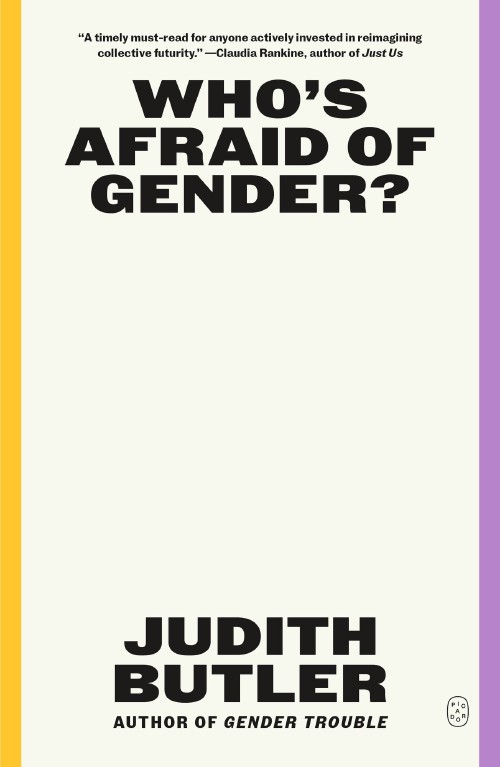
Who's Afraid of Gender
Copyright 2025, Picador
Climate Change, Cultural Analysis
Can we even say how many contemporary fears gather at the site of gender? Or explain how the demonization of gender defects from, and covers over, legitimate anxieties about climate destruction, intensified economic precarity, war, environmental toxins, and police violence, fears we are surely right to feel andthink about? When the word “gen-der” absorbs an array of fears and becomes a catchall phantasm for the contemporary Right, the various conditions that actually give rise to those fears lose their names. “Gender” both collects and incites those fears, keeping us from thinking more clearly about what there is to fear, and how the currently imperiled sense of the world came about in the first place. Circulating the phantasm of “gender” is also one way for existing powers-states, churches, political movements—to frighten people to come back into their ranks, to accept censorship, and to externalize their fear and hatred onto vulnerable communities. (P6)
It is nearly impossible to bridge this epistemic divide with good arguments because of the fear that reading will introduce confusion into the reader’s mind or bring her into direct contact with the devil. Indeed, some who oppose “gender” do not read books in gender or feminist studies, queer or trans studies, queer of color critique, Black feminism, or any version of race theory. They are skeptical of the academy for fear that intellectual debates may well confuse them about the values they hold. Their refusal to care much about consistency, to base their criticisms on a reading of the text, their way of snatching phrases and making them into lightning rods, however, are all finally a refusal to think critically, by which I mean, at the least, exercising the freedom of thought to turn over an issue and examine its presuppositions, limits, and potentials. (P21)
Considered more broadly, gender names the dilemma of how to conjoin social categories and lived forms of embodiment-through what means, and with what force? There are brutal and unjust ways of forcing that conjunction, and there are promising and even emancipatory ways of embodying both that conjunction and disjunction. (P34)
Stock’s argument for not letting trans women into women’s spaces—an overtly discriminatory position—seems based on the notion that women will feel unsafe if there is a penis in the room. Where does that idea come from? What power is given to the penis in such a scenario, and what does it actually represent? Is the penis always threat-ening? What if it is limp or simply in the way, or the last thing on anyone’s mind? When we raise our sons, do we recoil from their penises as if they were always and only potential threats to women? I am sure that is not the case, or perhaps I should more fervently hope that is not the case. Calling for segregation and discrimination can only seem “reason-able” when this phantasmatic construal of the penis as weapon is organizing reality. But that view cannot withstand the critical scrutiny of how analogy and generalization work in this position. If we were to find evidence, for example, that two Black people have committed crimes, do we then demand social policies that would make the entire Black community pay for those crimes? Or if one Jewish person overcharges for a transaction, are we then free to generalize about the avaricious character of Jews as a class? Clearly, we are not justified in doing so. (P158)
Still, Pope Francis claims that “gender” is an example of colonization imposed upon poor, local communities. Is he truly speaking for the disenfranchised here? One problem with this view is that it imagines “local cultures” as never having been queer or gay or trans. It is of no interest to the Pope or others who make such claims that gender complexity and range are found throughout Indigenous forms of kinship and language, and that the gender binary actually disturbed other arrangements of kinship and reference at play for many peoples who already made room for gender-nonconforming people, including intersex children. It was actually colonialism, and the kind of market expansion upon which it relied, that established the binary and heteronormative framework for thinking about, and living, gender. If we consider the work of the feminist philosopher Maria Lugones, which draws on the work of Aníbal Quijano, the Peruvian sociologist," then colonial arrangements are the context for understanding a wide range of issues that we think of as belonging to normative gender relations, including heteronormativity, dimorphic idealism, the patriarchal fam-ily, and the very norms that govern the normativity of gender appearance. (p220)
Construing “gender” as an enemy works only by bringing together opposing political trends and bundling oscillating fears without having to reconcile them logically, that is, without counterfeit accountability. In this way, the phantasm functions as a counterfeit synthesis. (p230)
“Gender” crosses borders, makes its way inside, and is in that sense insidious. But is it insidious like a foreign power, or has it become anyone’s word, a strange transnational democratization at the level of vocabulary? Unfortunately, when reflections on gender take place in English as if everything said is translatable, that does constitute an arrogant presumption, one that can be countered only by thinking about gender as a scene of translation. (P232)
We have to be prepared to translate between a language in which we live, the one that we require to live, and another’s language that dispossesses us from that sure sense of things that comes with monolingual conviction. After all, some find life and breath by escaping the terms by which gender recognition is conferred, and others find life and breath precisely through feeling recognized by existing terms, and some welcome or make the foreign term as a way of contesting the naturalizing function of lan-guage, or of English in particular.
If the task is not to generalize a way of life, but to become attuned to the various vocabularies that make life more livable, then a transphobic feminism is out of the question. Indeed, a transphobic feminism is no feminism, and it allies with forms of coercive gender norms that call for paternalistic or authoritarian enforcement. An anti-feminist trans position also has to rethink the history of feminism, especially Black feminism, for the profound and difficult alliances formed among all those emerging from subjugation who seek to have their claims for political recognition registered and honored. Those who should be most enraged by my argument are those who believe that the gender binary is mandated by a version of natural law referenced or occasioned by the Bible, or mandated by an Anglophone understanding of gender dimorphism crafted according to white ideals. They have a great deal to lose, and they should start that process of mourning. Let’s hope their destructive rage turns to productive grief so that they can emerge into a world committed to cohabitation and equality across difference. (p237)
“Equitable pluralism” may sound like a decent ideal, but Spivak asks us to consider that words exchanged are precisely not like coins. When translation proves to be obdurate or impossible, then the provisional character of the source language can be revealed, its epistemic limit, or its incapacity to include all possible ways of organizing the world. The sense of linguistic humility that follows runs counter to the cultural and linguistic imperialism that drives monolingualism, that is, the belief that any and all possible meaning can be, or should be, capturable by one’s own language, by English or French or another language that presumes its universal reach. (p241)
When gender is thus figured as a foreign invader or the invasion it-self, those battling gender reveal that they are in the business of nation-building and border patrol. The nation for which they are fighting is often built upon white supremacy or its furtive legacy, the heteronormative family, and a resistance to all critical questioning of norms that have clearly restricted the freedoms and imperiled the lives of so many people. To defend the use of gender in education and in everyday life, in policy and politics, is to affirm the value of openness and alliance, and to question monolingual imperative that is the legacy of imperialism. (P242)
No one really wants to imagine the future except those who foresee their businesses expanding and their capital accumulating, who see the future as the horizon of their own increasing power. To think that way is to not care whether that form of accumulation comes at the expense of the earth, other lives, or life in all its forms. And yet, in our acts and practices, we do implicitly reproduce an idea of the future, whether or not we know precisely what it is. We live this way now, assuming that living this way is the way to live, and once that repeated practice becomes a way of life, it comes to look like the way things simply are, or ought to be. But when the way of life that is reproduced destroys all ways of life, including its own, one has to ask how the pursuit of destruction is carried out by practices that are considered to be the way things just are, or have to be. Climate destruction is the most terrifying example. It teaches us, however, not only that many now live with a fear of destruction that their way of life has helped to produce. It teaches us also that many have no idea how to live with that fear of destruction, which is a fear not only about the future in which events can happen at all but also about what is happening now, and what has been happening for some time. We look, we look away; we know, we fail to know. We live in the anxiety produced by knowing that we are not knowing what we secretly should and do know. (P246)
Maybe all this seems far from gender. But when gender is figured as a threat to humanity, civilization, “man,” and nature, when gender is likened to a nuclear catastrophe, the Ebola virus, or full-blown demonic power, then it is this escalating fear of destruction to which political actors appeal. They see the escalating fear and know that they can make use of it for their own purposes, so they escalate it even more. There is the ready and continuous fear of destruction, the source of which is difficult to name, which is solicited and spiked to fortify both religious authorities and state powers—or their strengthening alliance, as we see in Putin’s Russia, the Republican Party in the United States, and various countries in Eastern Europe, East Asia, and Africa. The displacement of this fear of destruction from its identifiable conditions of production— climate disaster, systemic racism, capitalism, carceral powers, extrac-tivism, patriarchal social and state forms—results in the production of “cultural” figures or phantasms invested with the power to destroy the earth and the fundamental structures of human societies. Precisely because that destruction is happening without its sources being named and checked, the fear and anxiety congeal without a proper vocabulary or analysis, and “gender” and “critical race theory” are produced and targeted as the causes of destruction. Gender is not just a matter of individual identity, but a category that describes the division of labor, the organization of states, the unequal distribution of power. Gender has never been “merely cultural” but has been cast that way by opponents who want to regard gender as a secondary concern or those who believe that cultural pathologies are responsible for social worlds breaking apart. Once identified as a cause of destruction, gender itself must be destroyed, and what follows is censorship, the de-departmentalization of gender studies and women’s studies, the stripping of rights of health care, increased pathologization, restricting spaces for public gathering, the repeal or rejection of laws that protect against discrimination, and the passing of laws that segregate, silence, and criminalize those who are trying to live their lives without fear. All those laws say: No, you will live your lives with fear, or perhaps you will not even count as a life at all. (P247-248)
When the anti-gender movement says that gender will strip you of your sexed identity, they are trying to strip a group of people of their sexed identity. Their inversion and externalization should be read as a confession: it is rights-stripping that they are advocating. They warn against “recruiting” by gay and lesbian teachers or books, but they are recruiting the public into a phantasmatic scene in which they are the ones who are being stripped of a sexed identity by progressive laws. Now, one might expect that identifying with such a position might expand powers of sympathy or concern, but in this case, the rights-stripping of trans people is fully absorbed and occluded by the identification that the public is asked to feel. In other words, they are the only ones at risk of losing their sexed identity. The only way out for them is apparently to deny the rights of sex assignment to trans people. Yet trans rights to self-determination take no one else’s rights away. Self-assignment is a form of freedom to live a livable life, a collective freedom that has been achieved through struggle. It is, however, twisted into a rights-stripping activity in order to justify stripping trans people of their rights. Simi-larly, queer families do not negate heterosexual ones. They only dispute the inevitability and superiority of the heteronormative family form. (P251)
It is, then, crucial that gender politics oppose neoliberalism and other forms of capitalist devastation and not become their instrument, that it opposes the continuing of colonization and all forms of racism, including those afflicting migrants, and that it takes its stand within expanding alliances. Gender politics is not rightly described as “identity” politics if its ultimate goal is to create the world in which we all want to live. It is by virtue of our interdependency that we stand a chance of surviving and flourishing. Can we make alliances that reflect that interdependency with both human and nonhuman life, that will oppose climate destruction and stand for a radical democracy informed by socialist ideals? (P259)
For the critique of financial coercion and cultural imperialism to become an integral part of a transnational gender politics, we will need to remind people why and how they desire to live, reclaiming life for the Left, finding life in the relations that sustain us, the alliances formed among all those who seek to realize equality and freedom within a livable world, an enduring and regenerative earth. This means living with our profound differences without succumbing to the destructive forms we must oppose. (P260)
We cannot oppose discrimination against ourselves only to support it for others. We cannot oppose systematic forms of hatred against one group by allying with those who would intensify that hatred in multiple directions. We cannot censor each other’s positions just because we do not want to hear them. It is no time for any of the targets of this movement to be petty and divisive, for to defend gender studies and the importance of gender to any concept of justice, freedom, and equality is to ally with the fight against censorship and fascism. (P264)